
Humans Change the World ! All these Earthquakes, who or what is responsible?
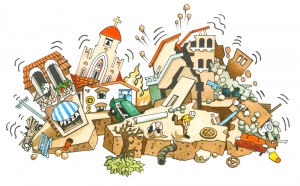
All these Earthquakes, who or what is responsible? In our blog from November 24, 2011, GreenDustries discussed the fact that “Humans Change the World”. What took 4 billion years to evolve is vanishing in the blink of an eye.
In our blog posted on December 8, 2011 we discussed how the “industrial revolution” has made our lives very easy and at the same time is destroying our planet. Starting with mining for commodities such as minerals, metals and rocks, let’s not forget all the underground nuclear explosions and the pumping of oil, our planet is looking more and more like swiss cheese and it is letting us know through: earthquakes, volcanoes and the increase of CO2. The time to change our ways is here and now! We are starting a series of blogs, where we will talk and explain topics and events that are relevant to our precedent posts. Why is all of this is happening now?
First Earthquakes. Everyone knows what an earthquake is, more or less. Are we responsible for all these earthquakes? What triggers an earthquake to happen, we do not really think about it, it is an important question.
As we discussed in the previous blog posted December 19, 2011, “What’s under our feet? The Earth’s structure is a bit like an egg…”, we asked the following question: Are we responsible for all the Earthquakes that are happening on our planet? We will try to give you in this blog all the material to read for you to decide what’s really going on.
“Earthquakes are the Earth’s natural means of releasing stress. When the Earth’s plates move against each other, stress is put on the lithosphere. When this stress is great enough, the lithosphere breaks or shifts. Imagine holding a pencil horizontally. If you were to apply a force to both ends of the pencil by pushing down on them, you would see the pencil bend. After enough force was applied, the pencil would break in the middle, releasing the stress you have put on it. The Earth’s crust acts in the same way. As the plates move they put forces on themselves and each other. When the force is large enough, the crust is forced to break. When the break occurs, the stress is released as energy which moves through the Earth in the form of waves, which we feel and call an earthquake.
There are many different types of earthquakes: tectonic, volcanic, and explosion. The type of earthquake depends on the region where it occurs and the geological make-up of that region. The most common are:
- Tectonic earthquakes. These occur when rocks in the earth’s crust break due to geological forces created by movement of tectonic plates. The earth’s crust breaks due to geological forces on rocks & adjoining plates cause physical and chemical changes. This is because of the movement of the magma and that is why the earth’s crust breaks.
- Volcanic earthquakes, occur in conjunction with volcanic activity. It is an earthquake that results from tectonic forces witch are made with volcanic activity. Earthquakes related to volcanic activity may produce hazards witch include ground cracks, ground deformation, and damage to man-made structures. There are two general categories of earthquakes that can occur at a volcano: volcano-tectonic earthquakes and long period earthquakes.
- Collapse earthquakes are small earthquakes in underground caverns and mines. They are small earthquakes in the underground and in mines that are caused by seismic waves produced from the explosion of rock on the surface. The immediate cause of ground shaking is the collapse of the roof of the mine or cavern. An often- observed variation of this extraordinary event is called “mine burst”.
- Explosion earthquakes result from the explosion of nuclear and chemical devices. This occurs when enormous energy nuclear is released during underground nuclear explosions, which when bottled within, increases a thousand times more than the atmospheric pressure, in intensity.
“We can measure motion from large tectonic earthquakes using GPS because rocks on either side of a fault are offset during this type of earthquake”. Says: nasa.org
What about “Fracking?” According to geologists, it isn’t the fracking itself that is linked to earthquakes, but the re-injection of waste salt water (as much as 3 million gallons per well) deep into rock beds.
Industry scientists deny the link to earthquakes, arguing that energy companies have been fracking for nearly sixty years. However it’s only a dozen years ago that “slick-water fracks” were introduced. This form of fracking uses huge amounts of water mixed with sand and dozens of toxic chemicals like benzene, all of which is injected under extreme pressure to shatter the underground rock reservoir and release gas trapped in the rock pores. Not only does the practice utilize millions of gallons of freshwater per frack (taken from lakes, rivers, or municipal water supplies), the toxic chemicals mixed in the water to make it “slick” endanger groundwater aquifers and threaten to pollute nearby water-wells.
I think it’s really hard to deny there’s a connection when the frequency of Arkansas earthquakes dropped by two-thirds when the Arkansas Oil and Gas Commission banned fracking. Note that they didn’t stop entirely, which suggests that fault disruption may persist even after fracking stops. Braxton County West Virginia (160 miles from Mineral) has experienced a rash of freak earthquakes (eight in 2010) since fracking operations started there several years ago. According to geologists fracking also caused an outbreak of thousands of minor earthquakes in Arkansas (as many as two dozen in a single day). It’s also linked to freak earthquakes in Texas, western New York, Oklahoma, and Blackpool, England (which had never recorded an earthquake before). Horizontal drilling and multi-stage fracking (which extend fractures across several kilometres) were introduced in 2004.
Braxton County West Virginia also experienced a marked reduction in their quakes after the West Virginia Oil and Gas Commission forced fracking companies to cut back on the pressure and rate of salt water injection into the bedrock). According to a joint study by Southern Methodist University and University of Texas-Austin, earthquakes started in the Dallas/Fort Worth region after a fracking disposal well there began operating in 2008 and stopped when it was closed in 2009. Braxton County West Virginia (160 miles from Mineral) has experienced a rash of freak earthquakes (eight in 2010) since fracking operations started there several years ago. According to geologists fracking also caused an outbreak of thousands of minor earthquakes in Arkansas (as many as two dozen in a single day). It’s also linked to freak earthquakes in Texas, western New York, Oklahoma, and Blackpool, England (which had never recorded an earthquake before).
According to National Geographic: Human-Caused Quakes
Coal mining isn’t the only human activity that can trigger earthquakes.
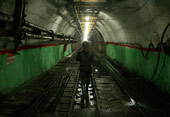
“Klose has identified more than 200 human-caused temblors, mostly in the past 60 years. “They were rare before World War II,” he said. Most were caused by mining, he said, but nearly a third came from reservoir construction. Oil and gas production can also trigger earthquakes, he added. Three of the biggest human-caused earthquakes of all time, he pointed out, occurred in Uzbekistan’s Gazli natural gas field between 1976 and 1984. Each of the three had a magnitude greater than 6.8, and the largest had a magnitude of 7.3. Human-triggered earthquakes are particularly dangerous, Klose said, if they occur in seismically inactive areas. That’s partly because people aren’t prepared for them. But also, he said, “regions that are naturally inactive are very trigger-sensitive, because stress has built up over long periods of time.” Klose’s presentation drew considerable attention from the assembled geophysicists, who wondered if there were ways to reduce the risk by altering mining practices. “One way would be to find a way that doesn’t reduce the water in the mine,” Klose said. But as far as he knows, mining engineers aren’t examining this, because they are currently unaware of the earthquake risk. The danger is also relevant to proposals to sequester carbon dioxide by injecting it into geologic formations deep underground where the gas cannot escape and contribute to global warming. “That alters stress in the crust,” Klose said, adding that the risk of earthquakes should be taken into account in planning the locations of such facilities. Basically, he said, “don’t put the injection fields close to large cities.”
The research could also have an impact on earthquake-insurance premiums, André Unger of the University of Waterloo, in Ontario, told National Geographic News by email. The precise method by which premiums are calculated is a deeply guarded trade secret, but they appear to be based on a region’s historical earthquake risk—”a purely statistical methodology,” he said. The new finding indicates that other factors are now at work, he said. Furthermore, Unger noted that underground carbon sequestration might be a mixed blessing from insurance companies’ points of view. A carbon-sequestration plan could reduce the risk of some types of damage (such as from hurricanes, which some scientists say are being strengthened by global warming), while increasing the risk of others, like earthquakes”. Says nationalgeographic.com
All our quotes and descriptions come from known Scientific Organisations like “NASA” and “National Geographic”. The National Geographic Society has been inspiring people to care about the planet since 1888. It is one of the largest non-profit scientific and educational institutions in the world. Its interests include geography, archaeology and natural science, the promotion of environmental and historical conservation.
“Nobody ever did, or ever will, escape the consequences of his choices.”
Alfred A. Montabert



Great! http://www.greendustriesblog.com. Thank you!
Youre so cool! I dont suppose Ive learn anything like this before. So good to find somebody with some original ideas on this subject. realy thank you for starting this up. this website is something that is wanted on the net, someone with a little originality. useful job for bringing one thing new to the web!
hey there and thank you for your information – I have certainly picked up something new from right here. I did however expertise several technical points using this site, as I experienced to reload the site lots of times previous to I could get it to load properly. I had been wondering if your hosting is OK? Not that I am complaining, but slow loading instances times will sometimes affect your placement in google and could damage your high quality score if ads and marketing with Adwords. Anyway I am adding this RSS to my email and can look out for much more of your respective intriguing content. Ensure that you update this again soon..
you’ve gotten a terrific weblog right here! would you wish to make some invite posts on my weblog?
very good post, i actually love this web site, keep on it
Hi Joselyne! Thank you for your post…
Wonderful website you have here but I was wanting to know if you knew of any forums that cover the same topics discussed here? I’d really like to be a part of online community where I can get feedback from other knowledgeable individuals that share the same interest. If you have any suggestions, please let me know. Thanks a lot!
Hi we do not know about any specific forum on that subject. You can check out the “Copenhagen report” for Climate Change. For that particular subject, I am not aware of any forum. I wish it would exist! Thank you! http://www.greendustriesblog.com
Hi, consciousness of the environment is what we want to bring to every one! Thank you..
Hi, what kind of blog do you have? http://www.greendustriesblog.com. Thank you for your post!
Hi, maybe it’s your computer? Try to clean your memory? Come back at : http://www.greendustriesblog.com for more read…. Thank you.
I would like to express my thanks to this writer for rescuing me from this type of crisis. After looking out through the online world and finding recommendations which were not pleasant, I was thinking my life was well over. Living minus the strategies to the issues you have resolved by means of your good guide is a critical case, and the ones which could have in a negative way affected my career if I hadn’t come across your web blog. That mastery and kindness in dealing with every aspect was useful. I don’t know what I would’ve done if I had not come across such a subject like this. I can also now look ahead to my future. Thanks so much for the reliable and effective help. I won’t hesitate to endorse your site to anybody who wants and needs support about this subject.
It’s best to participate in a contest for among the finest blogs on the web. I will recommend this site!
Excuse my stupidity, but I can’t seem to find your sites rss feeds. Mind directing me to it? Thanks.
Hi Christian, we fixed the problem, you should be able to use it freely now…Thank you.
Please do. Thank you!
Thank you Marvin. How did you find us? A simple way is to go
@www.greendustriesblog.com. We are feeling so happy that we was able to help….Best regards.
Along with everything that appears to be building inside this specific subject matter, many of your opinions are actually rather refreshing. Nevertheless, I beg your pardon, but I can not subscribe to your whole theory, all be it exhilarating none the less. It seems to everyone that your comments are not completely validated and in actuality you are generally your self not wholly confident of your argument. In any event I did enjoy reading through it.
It’s exhausting to search out educated individuals on this topic, however you sound like you realize what you’re talking about! Thanks
Discovered your article really exciting certainly. I seriously appreciated studying it and you simply make quite some great details. I’ll bookmark this web site with the long term! Terrific post.
I really like what you’ve done with the thmeme but I was asking myself if you are the one that created it or you just bought it and customized it?
Thanks, we got the fee theme and customized it. 🙂
I found your blog site on google and check a couple of of your early posts. Proceed to keep up the superb operate. I just additional up your RSS feed to my MSN News Reader. Looking for forward to reading extra from you afterward!…
I wish to convey my admiration for your generosity in support of men who should have help with in this issue. Your personal commitment to getting the message around has been definitely useful and have frequently permitted employees much like me to arrive at their dreams. The warm and friendly key points entails so much a person like me and extremely more to my mates. Warm regards; from everyone of us.
I was studying some of your content on this site and I believe this web site is very informative ! Continue putting up.